
City Digital Twins: How Urban Simulations Are Changing Infrastructure Management
City digital twins are shifting urban management from reactive maintenance to evidence-based planning. Instead of relying on scattered sensor dashboards and historical reports, engineers and city teams can use a living virtual model of the city to test changes, anticipate risks, and coordinate decisions across transport, utilities, and public services. By 2025, this approach is no longer experimental: it is increasingly tied to real operational workflows, from asset management to emergency response.
What a City Digital Twin Really Is in 2025
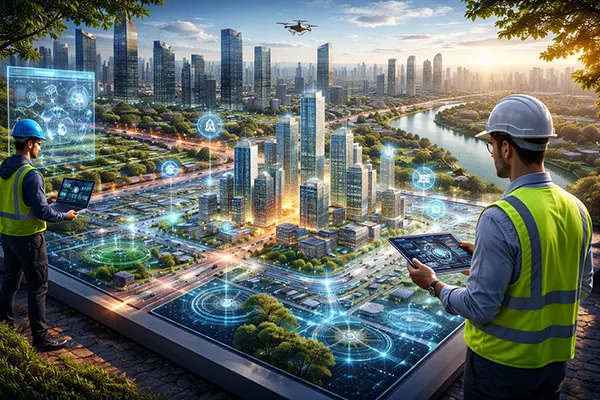
A city digital twin is more than a 3D model. In practical terms, it is a connected system that links geospatial data, engineering records, and live or near-real-time inputs (such as traffic counts, energy consumption, air quality readings, and IoT signals). The goal is to create a consistent “single reference” view so that multiple departments can work from the same assumptions and data definitions, reducing mistakes that happen when teams operate with incompatible maps or outdated asset inventories.
In 2025, the most useful twins combine three layers: a geometric layer (streets, buildings, terrain), an asset layer (pipes, cables, substations, signals, bridges), and a behaviour layer (how the city “acts” under different loads and scenarios). This behaviour layer is where a twin becomes operational: it can simulate congestion patterns after a road closure, water pressure changes during peak demand, or how heat islands develop during a summer event.
Another important change is governance. Many cities now treat the twin as a managed data product, with clear ownership, access control, and update routines. Without those rules, the model degrades quickly and becomes a costly visualisation tool rather than a decision system. The best projects invest early in standards for metadata, versioning, and responsibility for updates when construction or maintenance work changes the real city.
Data Sources, Standards, and the “Reality Gap”
The quality of a twin depends on how well it closes the gap between the digital model and the physical city. That gap appears when sensor data is noisy, asset registers are incomplete, or construction updates are not reflected promptly. In 2025, leading city teams reduce this problem by combining multiple verification methods: comparing survey data with work orders, using automated change detection from aerial imagery, and enforcing update requirements in contractor handover processes.
Standards matter because a twin is usually assembled from many systems. Common building blocks include GIS datasets, BIM models for large projects, and citywide 3D tiles for visualisation. The challenge is that these datasets were historically created for different purposes, at different resolutions, and with different naming conventions. To avoid confusion, cities are increasingly adopting shared ontologies and consistent asset identifiers so that “the same object” is recognised across departments.
It is also worth being honest about limitations. A twin is not a guarantee of truth; it is a controlled approximation. The responsible approach is to show confidence levels, data freshness, and known blind spots. If a water network section has poor sensor coverage or uncertain pipe materials, the twin should make that visible rather than hiding uncertainty behind polished graphics.
How Simulation Changes Day-to-Day Infrastructure Decisions
The biggest operational value comes when a twin supports routine decisions at a faster pace than traditional studies. For example, traffic engineers can test signal timing changes in a simulated environment before deploying them, reducing disruption. Utility teams can forecast demand spikes and plan maintenance windows with less risk, because the twin can estimate knock-on effects across the network.
Maintenance planning also becomes more targeted. When asset condition data is linked to failure histories and local environmental factors (such as ground movement, flooding risk, or salinity near coastal areas), teams can prioritise interventions more accurately. That means fewer emergency repairs and better budgeting, because investments are linked to measurable risk reduction rather than rough cycles.
Crucially, a twin helps cross-department coordination. A street excavation is not just a transport issue; it can affect drainage capacity, broadband duct access, emergency routes, and business activity. When those impacts are tested in one shared model, decisions tend to be less siloed. In 2025, this “coordination dividend” is often the reason cities keep funding a twin after the initial pilot phase.
Examples: Traffic, Water, Energy, and Public Works
In traffic management, simulation can support both strategic and tactical decisions. Strategically, teams can estimate the impact of new bus lanes, congestion charges, or low-emission zones. Tactically, they can respond to incidents: if a bridge lane is closed, the twin can suggest diversion routes and predict congestion hotspots, helping to place temporary signage and adjust signals quickly.
Water utilities use twins to model pressure, leakage, and quality risks. A common use is testing how the network behaves if a pumping station fails, or if a main pipe needs to be isolated for repair. Instead of learning through disruption, operators can simulate different valve strategies and choose the option that maintains service for the largest number of residents.
Energy and district heating teams apply twins to balance efficiency with resilience. When a city is integrating renewable generation, EV charging, or heat pumps, load becomes less predictable. Simulation helps grid operators plan reinforcement and manage peak demand. For public works, a twin can also reduce construction risk by checking clashes between underground utilities and planned foundations before work starts, lowering the likelihood of expensive surprises on site.
Risks, Ethics, and What Cities Must Get Right
Digital twins bring real risks if they are treated as purely technical projects. One concern is privacy: when mobility data, CCTV analytics, or device signals are integrated, it becomes easier to infer patterns about individuals or small groups. By 2025, responsible city programmes are designing data minimisation into the twin, using aggregation, anonymisation, and strict access control rather than trying to “fix privacy later”.
Security is another priority. A twin often connects to operational technology, or at least to systems that guide operational decisions. That makes it an attractive target. Strong practices include network segmentation, role-based permissions, audit logging, and security testing of integrations. The twin should not become a “single point of compromise” simply because it is convenient to centralise data.
There is also a governance risk: if only one vendor can maintain the model, cities can become locked into expensive long-term dependencies. A more resilient approach is to insist on open data formats where possible, keep documentation and data dictionaries under city control, and build internal capability so that key functions do not disappear when contracts change.
Responsible Use: Transparency, Resilience, and Public Trust
Trust grows when cities explain how decisions are made. A twin can help because it can show assumptions and scenarios, but only if the city is willing to be transparent about modelling choices. That includes publishing non-sensitive parts of the methodology, describing which datasets are used, and clarifying what the twin can and cannot predict.
Resilience planning is one of the strongest civic cases for twins in 2025. Climate risks such as heatwaves, heavy rainfall, and storm surges are pushing cities to test infrastructure under stress. Simulation can evaluate which neighbourhoods face the highest combined risk, what interventions would protect critical services, and how emergency resources should be positioned. When used well, the twin becomes a planning tool that connects engineering logic with public safety goals.
Finally, the twin should be judged by outcomes, not visuals. The most credible programmes track measurable benefits: fewer unplanned outages, shorter disruption time during incidents, better capital planning accuracy, reduced construction conflicts, and clearer inter-agency coordination. If a city can show those outcomes, the twin earns its place as a practical management system rather than a fashionable digital project.